 In Ben Lerner’s novel Leaving the Atocha Station, the main character Adam Gordon wanders around Madrid, screws different women, drinks, smokes, talks, sometimes coherently, and is otherwise on a sort of “gap year” funded by a Fulbright and fueled by the protagonist’s early success in poetry and ambition for more. As the book opens, Adam is cruising through the Museo Nacional Del Prado, pretty high, somewhat hungover, and in a half-lucid state coaxed by pills and weed only to come across a man before Weyden’s “The Descent from the Cross”. The man is weeping. He is, Adam decided, having “a profound experience of art.”
The protagonist (insofar as there is a protagonist in Lerner’s story, a plot, or a brick and mortar tale anywhere in here so much as the meandering thoughts often ascribed to modern fiction uuuugghhhh: does it have to be so, these draconian pronouncements?) yes, the protagonist is uncomfortable with the situation he encounters. “I had long worried that I was incapable of having a profound experience of art and I had trouble believing that anyone had, at least anyone I knew.’
Perhaps the author, too, is uncomfortable with this phrase, or at least intrigued enough to tease it out as the centerpiece for his novel. And this leaves me, the reader, to glean similar cues and follow form and to become, equally, unabashedly, uncomfortable. The move is equal parts solidarity and time management. (You tell me. I’m just visiting your quaint little town of a book, a painting, a film. I have somewhere else to be in short order— such is the usual hush and bustle and when I am on point and not too much distracted by prevailing states of awe and panic, both, and if conditions of life or life in a city or life in New York City specifically and most acutely, I don’t know but some combination, I suspect) well, I am no different.
Now there are three uncomfortable people in close, swirling vicinity—three parties ill at ease: the character, his creator, and his consumer. We’re locked in the museum, in this case the Museo Nacional Del Prado in Madrid, ourselves hanging from the walls and staring not at the art but at each other and in round if dispiriting agreement—the notion of a “profound experience of art” leaves us cold. It’s convoluted. You’re trying too hard. Stop being such a chump and get on with it—the whole of it, seeing everything, your eyes manic and scanning. Be a cool customer, not some involved sycophant.
Go on, take a picture if you like with that camera on your phone. The guards here don’t mind. The modern museum of ancient artifacts has not yet settled on a policy, any policy, regarding the appropriate management of digital device, their domains of capture, transfer, upload, tag, ping, and “like”. If you feel better, if it makes you feel better, experience the whole museum through that round little plastic hole, hovering above and looking without seeing, seeing without feeling as you, we, the lot of us, become the drones of art consumption. We swoop in on places of culture and bomb, flat out bomb, the true mission of our visit.
Because this is where we’re wrong to be uncomfortable, though it takes real practice not to reach for the camera phone, not to fly another drone mission through cubism and on, back in time, to pointillism. Not to activate that constant shudder speed of a thousand photos snapped at once to create a panoramic image for all eternity when what you really came here to do was to turn your own head—that most exquisite device of vision, synthesis, and comprehension. To create, however fleeting, your own experience before art. What is that experience? Could it be profound? It could. Do you dare to take yourself and the work, both, together, seriously? It is not an easy question. But what I really want to know is why we are all, all of us, so damn uncomfortable with the prospect, the possibility, of affording, however brief, a profound experience of art?
Adam?
Lerner built a whole novel around this totem of an idea. That he did so at this point in time signals a new height of debilitating insecurity in the modern cathedral of the art museum. Why can’t we look at art and be, perhaps, moved? Why do we continue to hide behind placards or glossy cards of explanation or, most recently, our phones and their doo-dah cameras, dutifully taking pictures we will never– not once– look at again? What the hell is our problem?
I am just like everyone else in my sneakers and my men’s coat, my bag full of jumbled nonsense carrying things forever lost even as they are still with me, yes, I am just like everyone else and yet today I overcame, however briefly, this problem. I will state unequivocally that, at the Met, I had a profound experience of art.
Plunk down a dollar or dime or a nickel on the counter and they will admit the New York resident. (In a distant yet coming and more generous time in my life I will make amends, hoisting whole buckets of not just loose change but good dollars in their double digit increments. I will push all the money across their counter and then refuse even a single ticket for the day, walking away with my hands in the thin of my pockets and a tune in my head, unencumbered by the weight of those buckets, their long overdue contributes.)
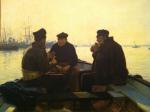
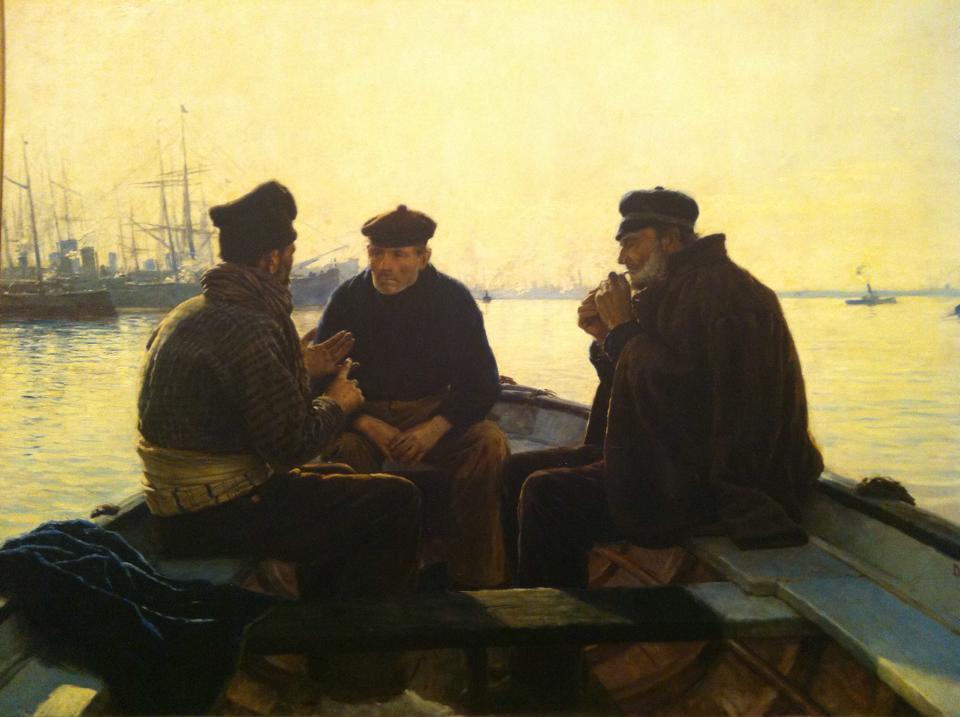
Having gained entry by whatever means, whatever form, it is straight upstairs—take them two at a time—then south, past all those dripping Degas and his creeping pastor’s attention to the ballerina’s form, and there, on an eastern wall in Gallery 827, you will find Dionís Baixeras i Verdaguer’s Boatmen of Barcelona (1886).
First off—the light.
Has there ever been a more honest, naked, or true depiction of early morning light as it comes blazing into day, primal and feasting upon the water, the boats, the men, their skin, pickled and blistered, now weathering everything yet still tender, the light, with faint creases of hope and dynastic beginning as all the best new days can and will have? The stark raving mad morning.
I’ve never seen it as I do here and I see it for miles in this painting. I shudder for the sake of the sky. How can it live up, now, to this, here? To what has been rendered in a space of 59 by 83 inches? The whole of what came below could have been a carnival of nonsense or a landscape of porcupines—I could not have cared less because the sky alone has been seen and put down here and does not change but allows you to stand, mouth agape, for hours, if you like, or for an hour, as I did. It does not change. This rendering of the sky plows through endless, beautiful morning.
I took a break from my view and found a guard.
“Is this part of the permanent collection?” I asked, gesturing around sort of wildly but meaning, only and ever, the Verdaguer. I didn’t want to be too specific. I didn’t want to be disappointed.
“Yes,” he said.
“So this won’t change? None of this will change? This won’t go away?”
“No.”
Good.
“Thank you.”
Satisfied, I went back and found place again, this time beside a Japanese couple snapping away with all kinds of devices, and a French woman who was on her phone and either making dinner plans or scheduling open-heart surgery, such was her weird alternation of nonchalance and urgency pierced through by the brusque because, you see, she is French.
They drifted away. All of them. Alone at last.
Beneath the sky—the men. Three of them, clearly fishermen. Hunched yet poised, engaged in serious exchange, perfectly rendered in dark, thoughtful shadow beneath all that ebullient sky. Working it out, facing their fates. One man counts off the fingers of his left hand, giving the report in detail. Another, forever locked in the posture of the day’s first smoke, sits listening. There is the calm water beneath, the slosh of the tide gently rising. Theirs is the focus of three men with something grave and serious and wholly unresolved at stake.
In a coda to its masterflash across the sky, the light makes a parallel appearance below, decking out the planks of the boat with long shafts that confirm the solid weight of a vessel holding, equally, the solid weight of these three men. Just look at the way that light—sneaking back in—glints now off the edge of a jacket. Skitters down the curve of a nose. Balance, focus, illumination, grist, levity. It’s all in relief yet equally, too, on full display. Is there another painting that both presents and toys with this tension to such arresting degree? Anyone can answer that question however he or she may like. I answer it with the Verdaguer.
For the hour I stood before this painting, I thought thoughts like these, and others I can’t remember, and more. I cried, looked, looked away, cried some more, wiped my face, and finally I walked away. I got to the stairs, walked down their marble glory, and walked out the front door. I left the museum. It had been a profound experience of art and, as I am sure Lerner, his supporters and detractors, maybe even Adam, would all agree: there is nothing wrong with that.
“Insofar as I was interested in the arts, I was interested in the disconnect between my experience of actual artworks and the claims made on their behalf,” Lerner’s Adam posits in the novel. “The closest I’d come to having a profound experience of art was probably the experience of this distance, a profound experience of the absence of profundity.”
Adam—get out of Spain. Fly to New York. Immediately step into a taxi at JFK. Have the man drop you at the Met. Walk up to the second floor and head dead south. Your destination is Gallery 827. Seek out the Verdaguer. Stand and spend time with it.
Call me when you’re done. You will find, by that point, all the pot and pills redundant if not distracting, disgusting.
I think you will have seen something new.




 Caroline M Cooper